
How to Find the Best Blood Centre Software: A Complete Guide to Going Paperless, AI-Driven, and Error-Free
In the high-stakes environment of a blood centre, precision is not a luxury—it is a requirement. Medical Officers and Lab Technicians face a daily battle against time, managing the delicate balance between donor intake, component processing, and patient demand. For decades, this ecosystem relied on heavy ledgers, manual calculations, and disparate spreadsheets.
However, the modern blood bank requires a digital backbone. The transition to a paperless, AI-driven system is no longer just about removing paper; it is about creating a safety net for your technicians and ensuring that every drop of blood is tracked, tested, and transfused with zero errors.
This guide outlines the essential modules and workflows that define top-tier Blood Bank Software, based on the operational realities of Indian blood centres.
1. Streamlining the Source: Advanced Donation Management
The quality of the blood supply begins at the donation camp. Traditional methods involve manual forms that are prone to handwriting errors and make it difficult to identify ineligible donors on the spot.
The Mobile-First Registration
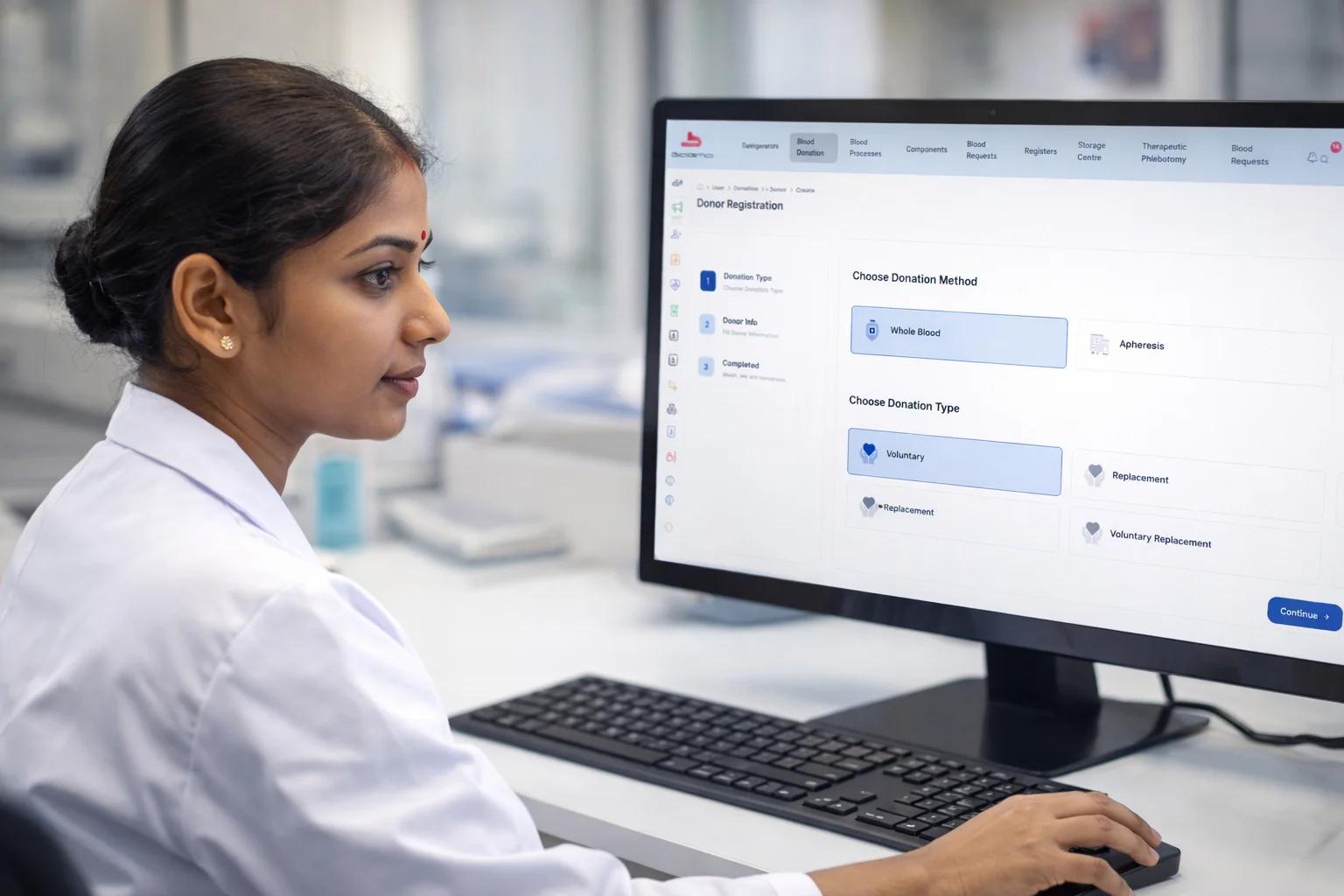
Effective software brings the system to the donor. Using a "Donor Registration" module that works on tablets or mobile devices, camp organizers can capture donor data instantly. This digital entry immediately syncs with a central database, allowing the system to perform real-time checks.
Intelligent Deferral Handling
One of the most critical features for donor safety is the management of deferred donors. A robust system maintains a live "Deferred Donors Register." When a donor’s details are entered, the software instantly runs a background check. If the donor was deferred at a previous camp (due to low hemoglobin, recent travel, or medical history), the system flags them immediately, preventing an ineligible donation and saving the cost of a collection bag.
Vitals and Counselling
The software should mirror the physical workflow. Modules for "Donor Counselling" and "Donor Vitals" allow the Medical Officer to input blood pressure, weight, and hemoglobin levels directly. The system can then automatically determine eligibility based on preset medical criteria, removing the burden of manual calculation from the staff.
2. The Laboratory: Automating Processing and Component Preparation
Once the blood reaches the centre, the complexity increases. A single unit of Whole Blood (WB) can be separated into multiple life-saving components like Packed Red Blood Cells (PRBC), Fresh Frozen Plasma (FFP), and Platelets (PLT).
Error-Free Component Separation
In a manual setup, technicians must calculate the volume and expiry date for each component individually. Modern software automates this via a "Component Preparation" module.
- Separation Methods: Technicians select the method (e.g., Buffy Coat or PRP), and the system guides the workflow.
- Volume Entry: As technicians enter the volume for PRBC, FFP, or Cryoprecipitate, the software validates the data against acceptable ranges.
- Auto-Expiry Calculation: The most valuable feature is the automatic assignment of expiry dates. The system knows that Platelets last 5 days and FFP lasts one year, assigning these dates to the labels automatically to prevent dispensing errors.
Testing and Approvals
Before any unit is released, it must pass rigorous testing. Integrated modules for "Grouping Tests" and "Screening Tests" (for HIV, HCV, HBsAg, etc.) ensure that results are digitally linked to the bag ID. The software enforces a "quarantine" status on all bags until the "Component Approvals" are digitally signed off by the Medical Officer.
3. Regulatory Compliance: The Digital Register System
For blood banks in India, maintaining registers under the Drugs and Cosmetics Act is mandatory. Doing this manually is the single biggest consumer of technician time.
Automated Register Generation
The best software eliminates the need for double-entry. As the operational work is done (donations collected, blood issued, tests run), the software automatically populates the statutory registers in the background. Essential registers include:
- Master Register: A complete log of all collections.
- Donor Deferred Register: Tracking rejected donors.
- Transmissible Disease Register: Logging reactive units.
- Component Register: Tracking stock production.
E-Raktkosh Integration
With the government’s push for centralized data, integration with the E-Raktkosh portal is non-negotiable. Capable software generates the "E-Raktkosh Monthly Report" automatically, formatting the data exactly as required by the national portal, ensuring compliance without manual data entry.
4. Inventory and Supply Chain Visibility
Managing a perishable inventory requires real-time intelligence. "Blind spots" in inventory lead to either stockouts during emergencies or wastage due to expiry.
Visual Dashboards and Analytics
A comprehensive "Inventory Dashboard" provides a bird's-eye view of the blood bank’s health. Usage analytics graphs help the management see trends—identifying which blood groups are in high demand and which components (like Cryo-Poor Plasma or Single Donor Platelets) are moving slowly.
Expiry Management
The software proactively manages the shelf life of the inventory. By tracking "Blood Bag Stock" digitally, the system can alert the team about units approaching expiry. This allows for the "First-In-First-Out" (FIFO) issuing policy to be strictly enforced, or for near-expiry units to be transferred to other centres via the "Transfer Bag Issue Register."
5. The Final Mile: Issuing and Patient Safety
The ultimate goal of the software is to ensure the right blood reaches the right patient. This is the stage where safety checks must be redundant and fail-safe.
Cross-Matching and Request Management
The "Blood Requests" module manages the flow from the hospital ward to the blood bank issue counter.
- Patient Requests: When a request is received, the system logs patient details and required components.
- Cross-Match Logic: The software should enforce compatibility rules. It prevents a user from allocating an incompatible group (e.g., A+ blood to a B+ patient) by locking the transaction and alerting the user.
Traceability
Every interaction is logged in the "Issue Register." This creates a permanent, unalterable audit trail detailing who requested the blood, who tested it, who cross-matched it, and who finally issued it. In the event of a transfusion reaction, the "Transfusion Reaction Register" helps in immediate investigation and root cause analysis.
Conclusion
Finding the best blood centre software is about looking beyond simple data entry. It is about finding a partner in operations—a system that understands the nuances of Component Preparation, the strictness of Regulatory Registers, and the urgency of Patient Safety.
By adopting a system that integrates these modules into a seamless, paperless workflow, blood centres can reduce operational stress, ensure 100% compliance, and, most importantly, focus entirely on their mission of saving lives.