
Transforming Blood Banking: How Bagmo Automates 40+ Statutory Registers and Empowers On-Demand Generative AI
Every day, blood centre teams face a mountain of regulatory documentation that can consume more time than actual patient care. A standard licensed Indian blood centre must comply with the Drugs & Cosmetics Act & Rules, maintain NABH accreditation standards, coordinate with NACO/NBTC guidelines, and report real-time inventory to national portals like e-RaktKosh.
In most facilities across the country, compliance still means maintaining dozens of heavy, manual, bound paper registers. Technicians and Medical Officers spend hours transcribing identical demographic, serological, and logistics data between separate ledgers. This duplicate work introduces human errors, causes mismatched data, and leads to high-stress pre-inspection rushes.
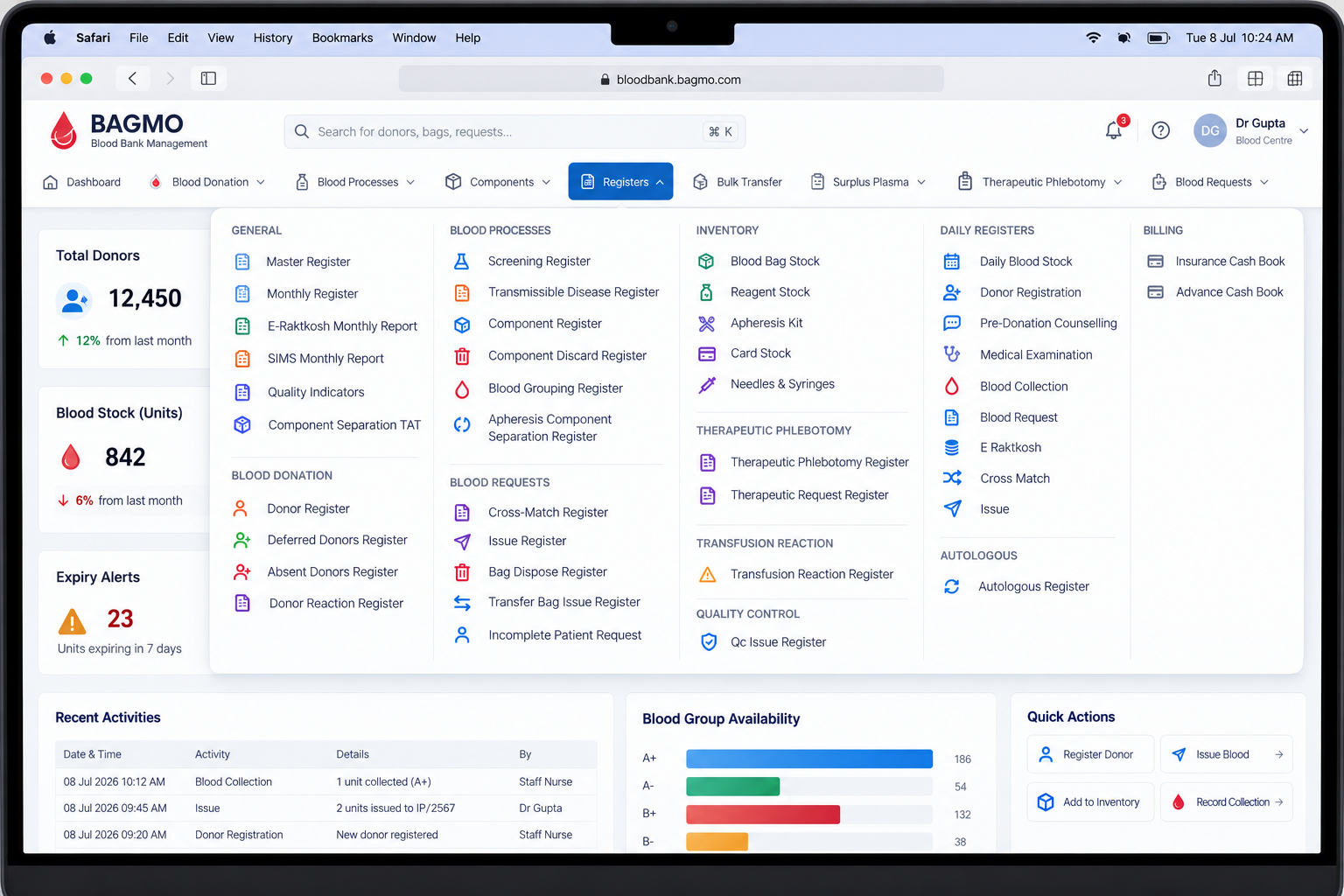
Bagmo Blood Bank Software removes this operational bottleneck. Built specifically for the Indian regulatory landscape, Bagmo serves as a complete digital backbone that automatically compiles over 40+ statutory and clinical registers in real time, backed by an AI engine that lets Medical Officers build customized, audit-ready registers on demand.
The Regulatory Burden in Indian Blood Centres
Under Part XII-B of the Drugs and Cosmetics Rules (1945) and successive amendments, every blood centre must maintain detailed records of donor qualification, processing, testing, storage, and distribution.
Concurrently, accreditation bodies like the National Accreditation Board for Hospitals & Healthcare Providers (NABH) demand granular tracking of Quality Indicators (QIs) and Hemovigilance data, including:
- Donor adverse reaction rates and classification
- Component preparation turnaround times (TAT)
- Wastage and discard root-cause analyses
- Transfusion reaction workups
- Strict cold-chain maintenance verification
When these steps are documented manually across separate ledgers:
Traceability Breaks Down: Tracing an issued component back through its quarantine release, ELISA/NAT run, cross-match sheet, and donor medical history requires pulling several physical books.
Data Duplication Multiplies Errors: A single donor unit requires recording donor vitals, blood collection records, grouping, component separation, screening results, and discard or issue data across at least six different journals.
Audit Scrambles: State Licensing Authorities (SLA), Central Drugs Standard Control Organisation (CDSCO) inspectors, or NABH assessors frequently spot documentation gaps that threaten licensing renewals or lead to non-conformance penalties.
Automated Regulatory Engine: 40+ Pre-Configured Registers
Bagmo captures clinical and laboratory data at the point of origin. When a donor is registered, a blood bag is barcode-scanned, an apheresis run is completed, or a serology report is approved, the relevant statutory registers update automatically in the background.
1. General Administration & National Reporting
- Master Register: The complete record tracking every collected unit from venipuncture to final disposition.
- Monthly Consolidation Register: Summarizes overall collections, screenings, component production, issues, and discards for administrative oversight.
- e-RaktKosh Monthly Report: Formatted to synchronize stock and activity directly with the central government portal without re-entry.
- SIMS Monthly Report: Configured for state-specific Strategic Information Management Systems reporting.
- Quality Indicators (QI) Register: Tracks mandatory NABH clinical metrics, including component conversion yields, discard percentages, and cross-match to transfusion ratios.
- Component Separation TAT Register: Measures the elapsed time from whole blood draw to component centrifuge separation, ensuring product efficacy.
2. Blood Donation & Donor Vigilance
- Donor Register: Complete demographic records, donor identification numbers, and recurring donation histories.
- Deferred Donors Register: Logs temporary and permanent deferrals with clinical rationale to prevent early recall.
- Absent Donors Register: Tracks no-shows from voluntary donation drives and scheduled replacement donor appointments.
- Donor Reaction Register: Documents donor adverse events (e.g., hematomas, vasovagal reactions) along with interventions and outcomes.
3. Blood Processes & Laboratory Diagnostics
- Screening Register: Consolidates all Transfusion Transmissible Infection (TTI) runs, capturing test kits, lot numbers, and expiry dates.
- Transmissible Disease Register: Documents seropositive confirmations for HIV I & II, Hepatitis B (HBsAg), Hepatitis C (HCV), Syphilis (VDRL), and Malaria.
- Component Register: Records preparation volumes and yields for Packed Red Blood Cells (PRBC), Fresh Frozen Plasma (FFP), Platelet Concentrates (RDP/SDP), and Cryoprecipitate.
- Component Discard Register: Tracks discarded units along with mandatory disposal reasons (e.g., seropositive, leakage, clotting, lipemic, expired).
- Blood Grouping Register: Records forward and reverse (cell and serum) grouping results, Rh phenotyping, and discrepancy resolutions.
- Apheresis Component Separation Register: Logs instrumental parameters, volume yields, and anticoagulant use during single-donor platelet/plasma collections.
4. Blood Requests & Patient Issues
- Cross-Match Register: Logs major and minor serological cross-match verifications, Coombs' testing, and AHG lot numbers.
- Issue Register: Verifies patient identity, hospital UHID, requesting physician, clinical ward, and issuing technologist prior to release.
- Bag Dispose Register: Tracks discarded clinical containers, bio-medical waste handovers, and empty transfer bags.
- Transfer Bag Issue Register: Records intra-facility satellite transfers and dispatches to mother or storage centers.
- Incomplete Patient Request Register: Flags requests rejected due to hemolyzed, unlabelled, or mismatched pre-transfusion samples.
5. Inventory & Supply Chain Tracking
- Blood Bag Stock Register: Reconciles incoming empty bag lots, manufacturer certifications, and usage rates.
- Reagent Stock Register: Tracks testing kits, antisera, and reagents with automated expiry warnings.
- Apheresis Kit Stock: Monitors disposable apheresis harness kits and storage levels.
- Card Stock Register: Tracks column agglutination cards and consumables.
- Needles & Syringes Stock Register: Maintains a verifiable count of phlebotomy consumables to ensure proper biohazard handling.
6. Specialized Procedures & Hemovigilance
- Therapeutic Phlebotomy Register: Documents clinically indicated phlebotomies for polycythemia vera or hemochromatosis.
- Therapeutic Request Register: Manages attending physician prescriptions, medical clearances, and hematocrit tracking.
- Transfusion Reaction Register: Tracks transfusion-related acute lung injury (TRALI), febrile non-hemolytic reactions, and hemolytic events with full lab workups.
- Autologous Transfusion Register: Tracks intraoperative collections, pre-deposit storage, and restricted unit administration.
- QC Issue Register: Records internal quality control evaluations of reagents, cell panels, and storage equipment.
7. Daily Workflow Registers
- Daily Blood Stock: Instant, group-wise reconciliation of safe, quarantined, and reserved blood products.
- Donor Registration & Pre-Donation Counselling Logs: Captures informed consent, risk factor disclosures, and counseling notes.
- Medical Examination Register: Records donor hemoglobin levels, vital signs, systemic examinations, and physical wellness checks.
- Daily Blood Collection & Cross-Match Issue Slips: Daily summaries of donations collected and cross-matched units cleared.
8. Billing & Financial Compliance
- Insurance Cash Book: Organizes cashless hospital admissions, Ayushman Bharat allocations, and state health-scheme reimbursements.
- Advance Cash Book: Tracks processing fee collections, advance security deposits, and non-insured service reconciliations.
How Bagmo AI Changes Register Creation
While fixed statutory registers cover standardized regulatory formats, real-world hospital operations often require unique data cuts.
State FDA inspectors, research committees, or internal hospital audit teams routinely request specialized, one-off analyses:
- "Provide a breakdown of all uncross-matched emergency O-negative PRBC releases sent to the surgical ICU over the last six months, including requesting physician notes and elapsed transfer times."
- "Show all platelets prepared from voluntary donors aged 18–25 that required secondary testing due to inconclusive group typing."
In older software systems, pulling this data required writing manual DB queries, submitting support tickets to vendors, or spending hours copy-pasting entries across spreadsheets.
Conversational Register Builder for Medical Officers
Bagmo includes a specialized, medical-grade generative AI engine built directly into its reporting core. This allows Medical Officers and Quality Managers to create custom, compliant registers using natural language:
Natural-Language Prompting: The Medical Officer enters the reporting requirement in plain English directly into the system.
Context-Aware Querying: Bagmo AI analyzes the request, maps it across the platform's relational database (donor records, cold-chain data, cross-match logs, component records), and extracts the matching parameters.
Structured Table Generation: In seconds, the AI produces a structured, standardized register complete with serial numbering, date stamps, and relevant technical data points.
Audit Preservation & Export: The generated register can be saved as a permanent monitoring template or exported immediately to PDF or Excel for external auditors. Every auto-generated register retains full data lineage, showing the original author, time of generation, and exact source records to uphold audit validity.
The Bedrock of Modern Blood Centre Management
Managing a blood centre requires high clinical precision alongside uncompromising regulatory discipline. When documentation remains tied to physical ledgers or fragmented spreadsheets, administrative overhead pulls clinical teams away from what matters most: donor safety, quality control, and timely patient care.
Bagmo Blood Bank Software eliminates paper-based compliance burdens. By automating over 40+ statutory registers and giving Medical Officers the power to build custom reports using natural-language AI, Bagmo sets the standard for modern blood centre management software. It helps blood centres eliminate audit anxiety, maintain complete vein-to-vein traceability, and operate at the highest standards of safety and compliance.
